




E20 Petrol Concerns: Government Clarifies Its Impact on Vehicles
Understanding E20 Fuel, Ethanol Blending, Government's Clarification & Public Reactions
If you've been active on social media recently, you've probably come across posts claiming that E20 petrol can damage your vehicle's engine, reduce mileage, attract insects, contaminate fuel, or even invalidate your vehicle insurance. These claims have sparked a nationwide debate among car and bike owners, with many questioning whether the government's push towards ethanol-blended fuel is safe.
The discussion gained momentum after several viral posts on X (formerly Twitter), YouTube videos, and WhatsApp forwards suggested that E20 fuel was causing problems in vehicles. One of the biggest rumours claimed that insurance companies could reject claims if E20 fuel caused engine damage.

As these concerns spread rapidly, the Government of India and the Ministry of Petroleum and Natural Gas (MoPNG) stepped forward to clarify the facts. Officials stated that many of the viral claims were misleading, scientifically incorrect, or taken out of context, urging people to rely on verified information instead of social media rumours.
But what exactly is E20 petrol? Why is India introducing it? Is it really safe for your vehicle? Let's understand everything in detail.
What is E20 Petrol?
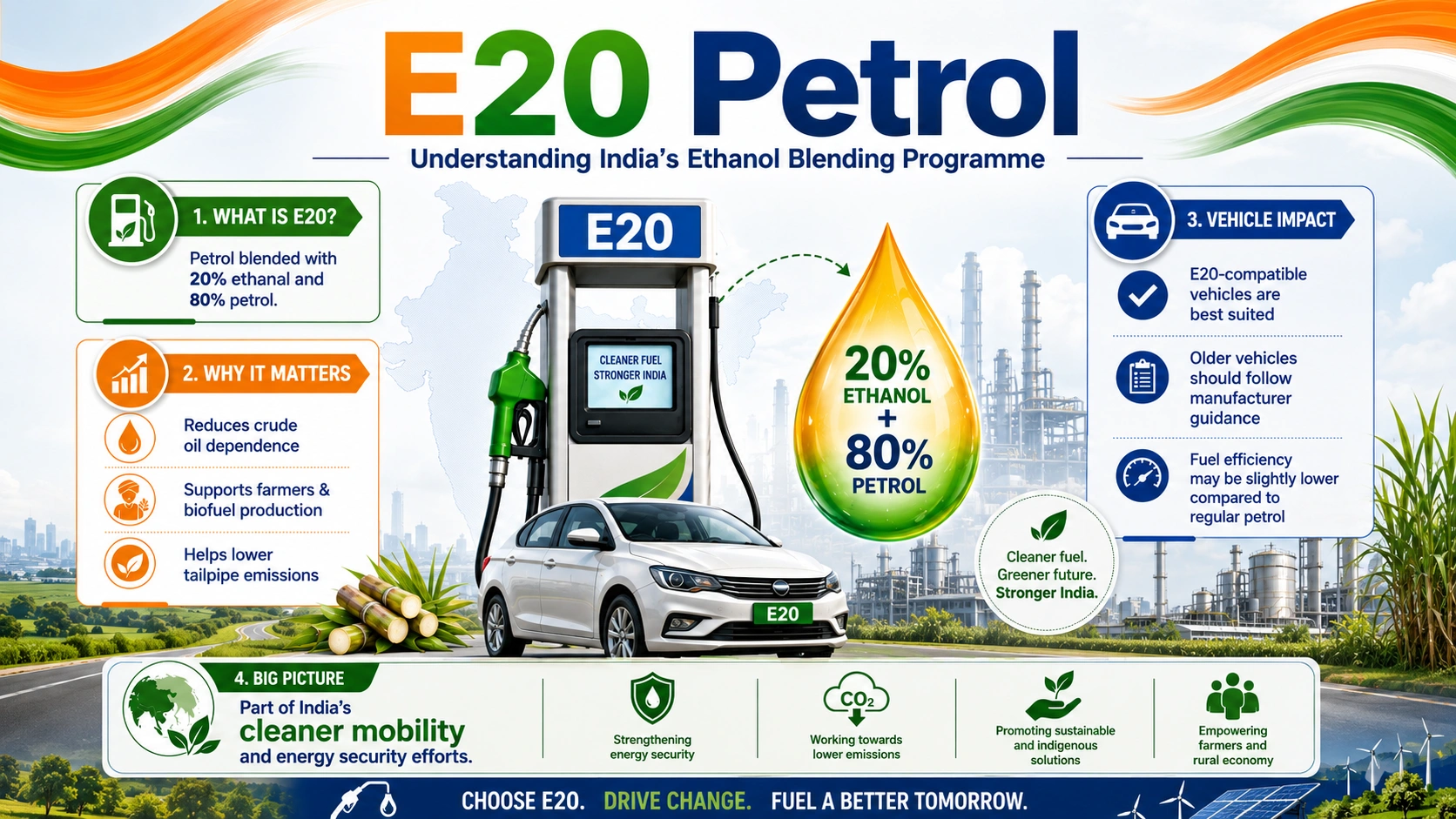
E20 petrol is a fuel blend containing 20% ethanol and 80% petrol.
Here:
- E = Ethanol
- 20 = 20% Ethanol
- 80% = Conventional Petrol
Instead of using pure petrol, India is gradually increasing the percentage of ethanol in fuel to reduce crude oil imports and make transportation cleaner.
The government's Ethanol Blending Programme (EBP) is one of India's biggest initiatives towards cleaner mobility and energy security.
Its major objectives include:
- Reducing dependence on imported crude oil
- Lowering carbon emissions
- Supporting Indian farmers
- Improving energy security
- Promoting renewable fuels
Understanding Ethanol Blending
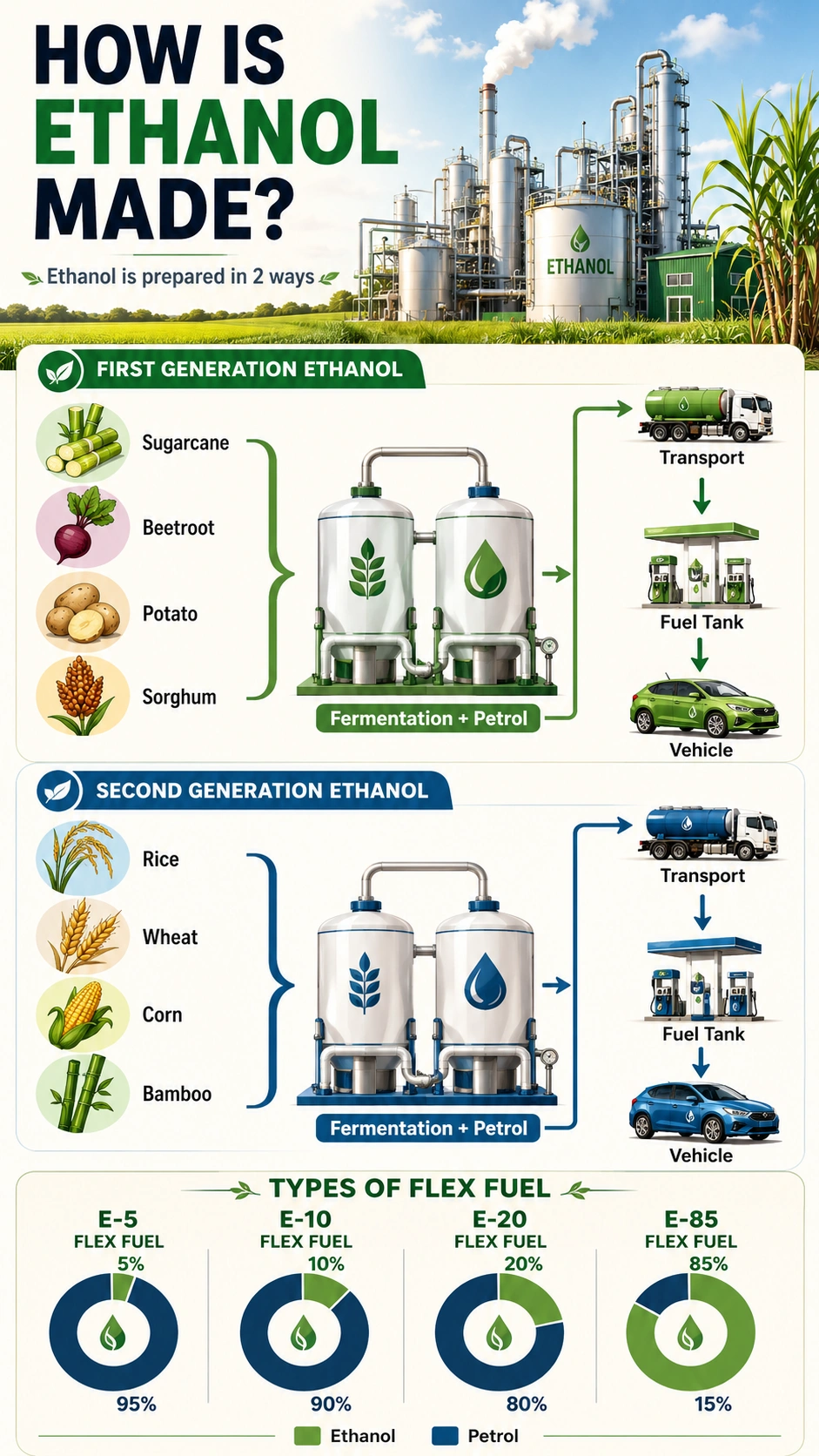
First Generation (1G) Ethanol
The first type of ethanol is produced from agricultural crops rich in sugar or starch, such as:
- Sugarcane
- Beetroot
- Potato
- Sorghum
These crops undergo fermentation and distillation to produce fuel-grade ethanol. The ethanol is then blended with petrol before being transported to fuel stations.
Second Generation (2G) Ethanol
India is also investing in second-generation ethanol, which uses agricultural residues and other biomass sources. As illustrated in the infographic, examples include:
- Rice-based feedstock
- Wheat
- Corn
- Bamboo
Second-generation ethanol helps utilize agricultural resources more efficiently and reduces waste.
Types of Ethanol Blends
The infographic also explains the different ethanol blends available globally:
| Fuel Type | Ethanol | Petrol |
|---|---|---|
| E5 | 5% | 95% |
| E10 | 10% | 90% |
| E20 | 20% | 80% |
| E85 | 85% | 15% |
India is currently promoting E20, while E85 is generally used only in specially designed flex-fuel vehicles.
Why is India Promoting E20 Fuel?
India imports a large percentage of its crude oil requirements every year.
This creates several challenges:
- High import bills
- Global price fluctuations
- Foreign exchange expenditure
- Dependence on international oil markets
By increasing ethanol blending, India aims to reduce these challenges while also encouraging domestic ethanol production.
According to government estimates, the ethanol blending programme has already helped save significant foreign exchange by reducing crude oil imports.
Why Did E20 Become Controversial?
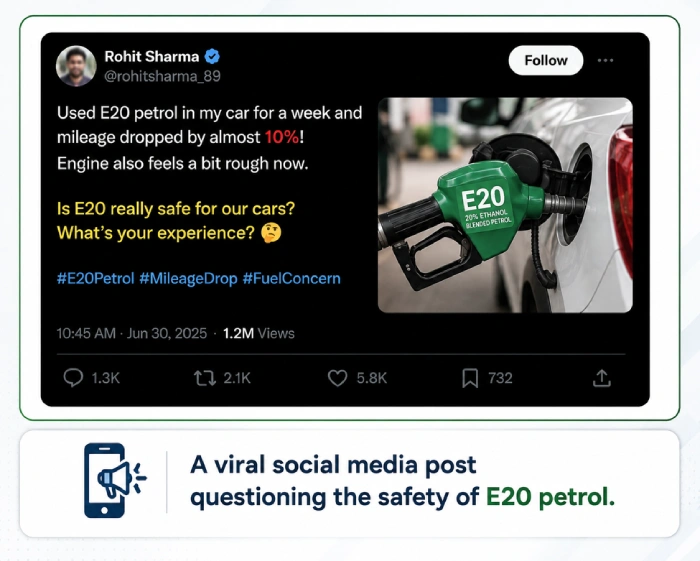
The controversy didn't begin because of an official report—it started on social media.
Numerous viral posts claimed that E20 petrol:
- Damages engines
- Causes injector failures
- Reduces mileage drastically
- Contains sugar that attracts ants
- Absorbs excessive moisture
- Invalidates vehicle insurance
- Is unsafe for older vehicles
As these posts spread across X, Facebook, YouTube and WhatsApp, many vehicle owners became concerned.
Government Responds to Viral Claims
To stop misinformation, the Ministry of Petroleum & Natural Gas released a detailed clarification.
According to the government:
- E20 fuel has undergone extensive scientific testing.
- It has been introduced after consultation with automobile manufacturers.
- The fuel is approved for compatible vehicles.
- Many viral claims circulating online are factually incorrect.
Officials also clarified that fuel-grade ethanol is produced through controlled industrial processes—not by directly mixing sugarcane juice with petrol.
Myth vs Fact
Myth 1: E20 Will Damage Every Engine
Government Clarification
There is no evidence of widespread engine failures solely because of E20 petrol. Modern vehicles manufactured for E20 compatibility are designed to operate using this blend. However, owners of older vehicles should always check their vehicle manufacturer's recommendations.
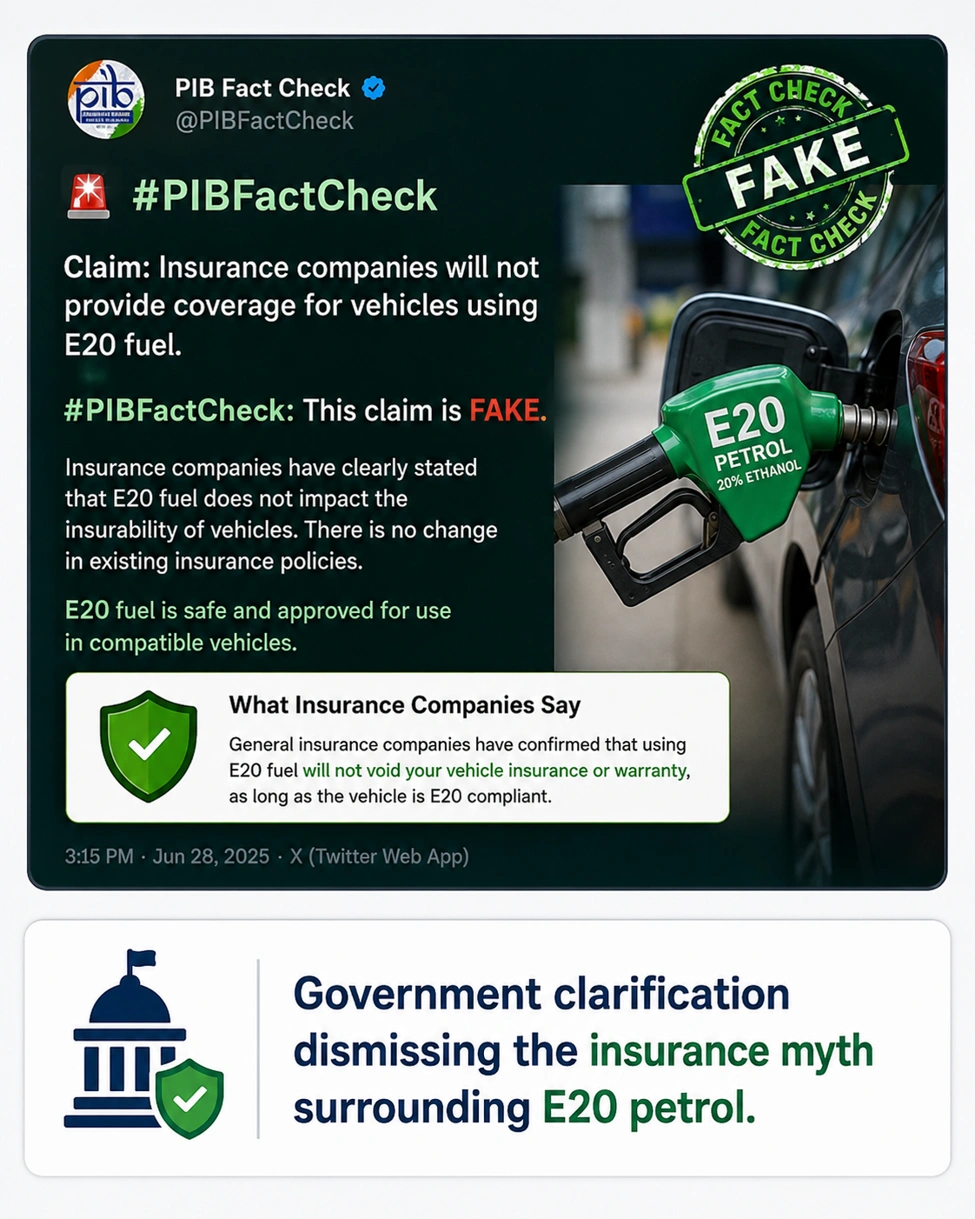
Myth 2: Insurance Claims Will Be Rejected
This became one of the biggest viral claims. Several posts suggested that insurance companies would reject claims if E20 fuel damaged the engine.
Government Response
The government has clarified that this claim is false. Motor insurance policies are not automatically void simply because a vehicle uses E20 petrol. Insurance companies evaluate claims based on policy conditions and the actual cause of damage—not merely on the use of approved E20 fuel.
Myth 3: E20 Contains Sugar
Many videos claimed sugar from ethanol attracts ants near fuel caps.
Government Clarification
Fuel-grade ethanol is a refined industrial product. It does not contain residual sugar. Therefore, the claim that ants gather because of sugar in E20 petrol has no scientific basis.
Myth 4: Water Easily Mixes with E20
People also claimed that E20 absorbs water so quickly that it damages engines.
Reality
Ethanol is hygroscopic (it can absorb moisture), which is a known chemical property. However, fuel distribution systems, storage standards, and vehicle fuel systems are designed to manage approved ethanol blends. The government says this characteristic does not make E20 unsafe when it is produced, stored, and used according to standards.
What About Mileage?
One concern raised by many motorists is reduced mileage.
Technically, ethanol contains slightly less energy than petrol.
Because of this:
- Some users may notice a small reduction in fuel efficiency.
- The exact impact varies depending on the vehicle, engine tuning, driving style, traffic conditions, and maintenance.
The government acknowledges that a minor reduction in mileage is possible but says it is expected and should not be confused with engine damage.
Is E20 Safe for Older Vehicles?
This is probably the most practical question.
The answer depends on your vehicle.
Many manufacturers have introduced E20-compatible vehicles in recent years. If your owner's manual specifically mentions E20 compatibility, you can follow the manufacturer's recommendation.
For older vehicles that were designed before E20 became common, owners should check the owner's manual, manufacturer advisory, or authorized service centre guidance. Using the fuel recommended by your vehicle manufacturer remains the best approach.
Benefits of E20 Petrol
Despite the controversy, E20 offers several potential long-term benefits.
1. Cleaner Emissions
Ethanol burns cleaner than petrol and can help reduce certain tailpipe emissions.
2. Reduced Oil Imports
Higher ethanol blending means India can reduce dependence on imported crude oil.
3. Better Energy Security
Greater use of domestically produced fuel improves energy resilience.
4. Support for Agriculture
Ethanol production creates demand for agricultural feedstocks, providing additional opportunities for farmers and related industries.
5. Progress Towards Sustainability
Renewable fuels play an important role in India's long-term environmental goals.
Public Reactions on Social Media
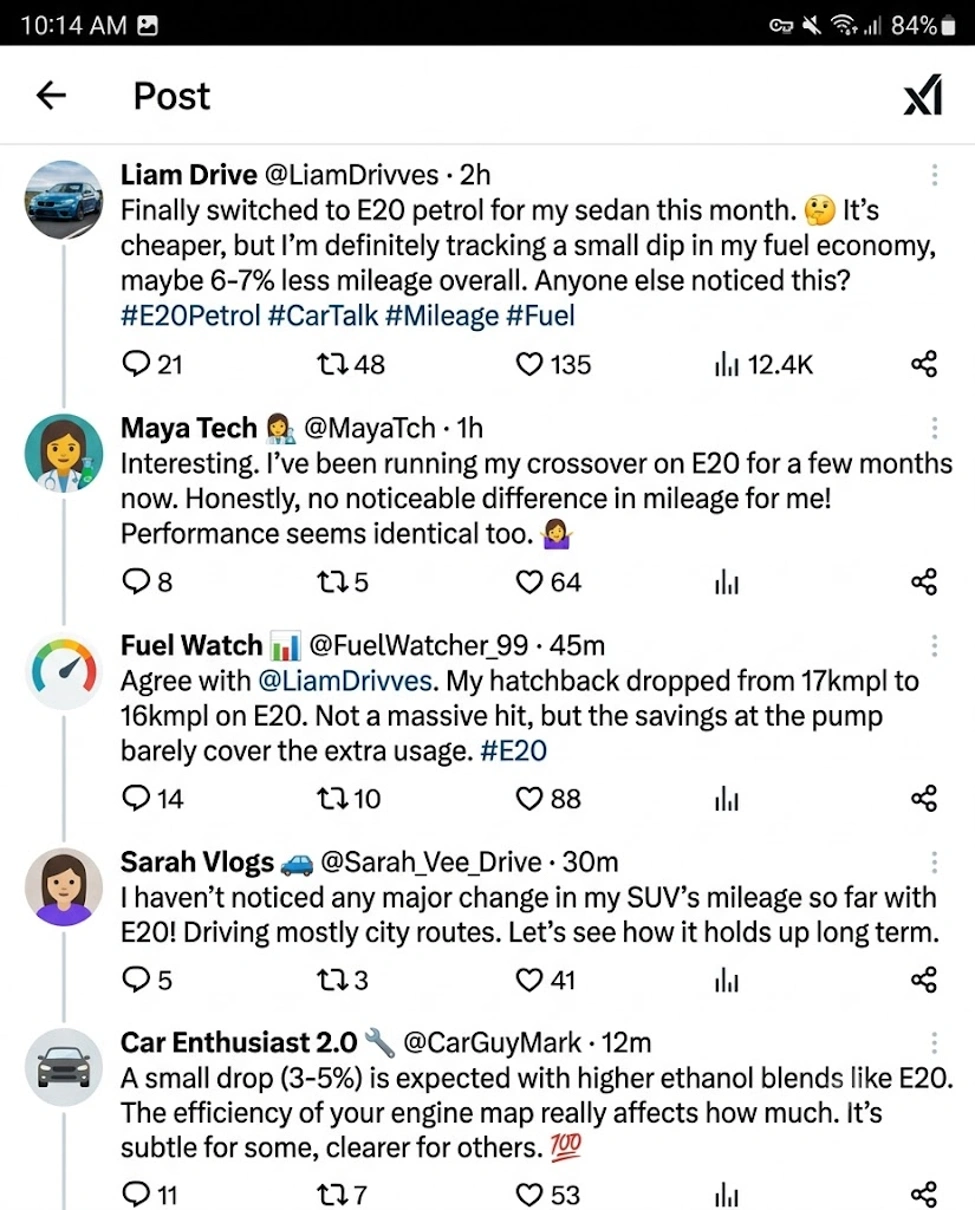
As the debate around E20 petrol gained momentum, social media platforms—especially X (formerly Twitter)—were flooded with opinions from vehicle owners, automobile enthusiasts, mechanics, and industry experts. While some users appreciated the government's move toward cleaner fuel, others questioned how it would affect mileage, older vehicles, and long-term engine performance.
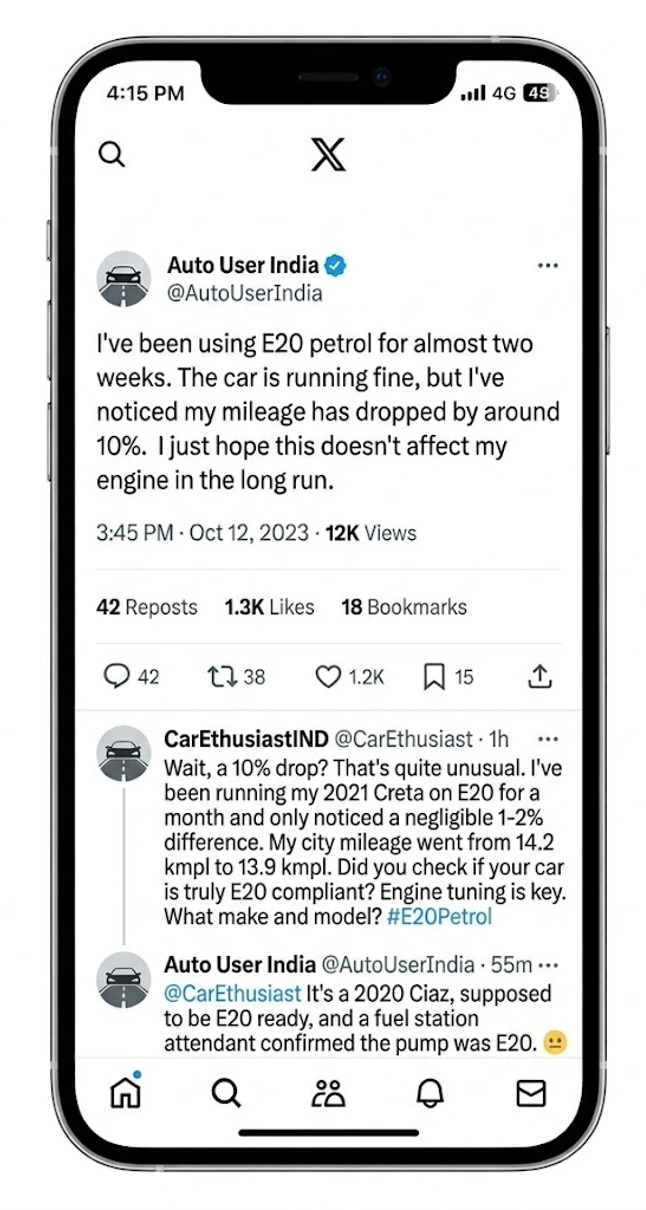
One User Said...
What Does This Mean?
This user's experience reflects one of the most common concerns surrounding E20 petrol—fuel efficiency. Since ethanol contains slightly less energy than conventional petrol, some drivers may notice a small reduction in mileage. However, a drop in fuel efficiency does not necessarily indicate engine damage. Factors such as driving conditions, traffic, vehicle maintenance, and engine tuning can also influence mileage.
Many experts suggest evaluating fuel performance over a longer period instead of drawing conclusions after just a few refuels.
Other People Had Different Experiences
Interestingly, not everyone shared the same opinion. Several users responded to similar discussions by saying they didn't notice any significant difference after switching to E20 petrol. Others supported the government's initiative, stating that cleaner fuels are necessary for India's future and that a slight reduction in mileage is acceptable if it helps reduce emissions and oil imports.

How Did People React?
The responses under these posts showed that public opinion remains divided.
Some users argued that:
- Modern vehicles are already designed for E20 compatibility.
- Cleaner fuels are essential for reducing emissions.
- India needs to reduce dependence on imported crude oil.
- Short-term concerns shouldn't overshadow long-term environmental benefits.
On the other hand, several users continued to raise valid questions, including:
- Are older vehicles fully compatible with E20?
- Will maintenance costs increase over time?
- Should consumers have the option to choose regular petrol?
- Is there enough long-term real-world data on engine performance?
Rather than rejecting E20 outright, many people simply wanted greater transparency, manufacturer guidance, and more long-term testing before forming a final opinion.
Another Concern Raised by Users

Why This Concern Matters
This viewpoint highlights an important issue—not every vehicle on Indian roads was originally designed with E20 fuel in mind. While many new vehicles are now E20-compatible, owners of older cars and motorcycles are understandably looking for clear guidance from manufacturers regarding compatibility, maintenance, and long-term performance.
This concern has been echoed across multiple online discussions and reflects the need for better consumer awareness rather than immediate conclusions about the fuel itself.
Final Take on Social Media Reactions
After reviewing hundreds of online discussions, one thing is clear: there is no single opinion that represents everyone.
Some motorists report positive experiences and believe E20 is an important step toward cleaner and more sustainable transportation. Others remain cautious, citing concerns about mileage, compatibility with older vehicles, and long-term maintenance.
At this stage, social media reflects a wide range of personal experiences, questions, and opinions rather than a unanimous verdict. Individual posts can provide useful insights, but they should not be treated as definitive evidence on their own.
As more drivers gain real-world experience with E20 petrol and additional long-term data becomes available, the conversation is likely to continue evolving. For now, the discussion remains open, with both optimism and caution shaping public opinion.
Tips for Vehicle Owners
If you are unsure about E20 compatibility:
- Read your vehicle's owner's manual.
- Check the manufacturer's official guidance.
- Follow the recommended service schedule.
- Avoid relying solely on unverified social media posts.
- Use fuel from authorized petrol pumps.
Final Verdict
The debate around E20 petrol demonstrates how quickly information—and misinformation—can spread online. While viral posts have raised concerns about engine damage, insurance rejection, and fuel quality, the Government of India has clarified that many of these claims are inaccurate or unsupported by scientific evidence.
At the same time, it is understandable that vehicle owners have questions about mileage, compatibility, and long-term performance—especially those driving older vehicles. These concerns deserve careful attention, but they should be evaluated using official guidance and manufacturer recommendations rather than viral posts alone.
The infographic above also highlights an important point: ethanol used in E20 is a processed industrial fuel produced through controlled fermentation and refining—not raw sugarcane juice mixed directly with petrol. Understanding how ethanol is made and blended helps clear up many common misconceptions.
As India continues expanding its ethanol blending programme, staying informed through reliable sources is the best way to separate facts from rumours. If your vehicle is approved for E20 use and you follow the manufacturer's recommendations, there is currently no official advice to avoid the fuel.
FAQ
There is no official evidence that E20 causes widespread engine damage in vehicles designed for it. Compatibility depends on the vehicle's design and manufacturer recommendations.
No. The government has clarified that approved E20 fuel does not automatically void motor insurance.
A slight reduction in mileage may occur because ethanol has lower energy density than petrol, but the impact varies by vehicle and driving conditions.
Availability is increasing across India as part of the national Ethanol Blending Programme, though implementation is being phased.
Owners of older vehicles should check the owner's manual or consult an authorized service centre before making assumptions about compatibility.
Related Blogs:
- Best Car Cleaning Service in Noida - Find the best car cleaning services in Noida and keep your car looking new.
- Car Detailing Products - Discover the best products for car detailing and how to use them to achieve a professional shine.
- Detailing Services for Different Cars - Learn about the different types of detailing services available for different types of cars and which one is best for you.
- Car Detailing for Different Seasons - Find out how to prepare your car for different seasons with the right detailing methods and products.
- How to clean your car's interior - Learn the 8 best techniques and products for cleaning the interior of your car, including the seats, dashboard, and carpets.

