




Car Segments in India Explained: A, B, C, D & SUV Categories (2026 Guide)
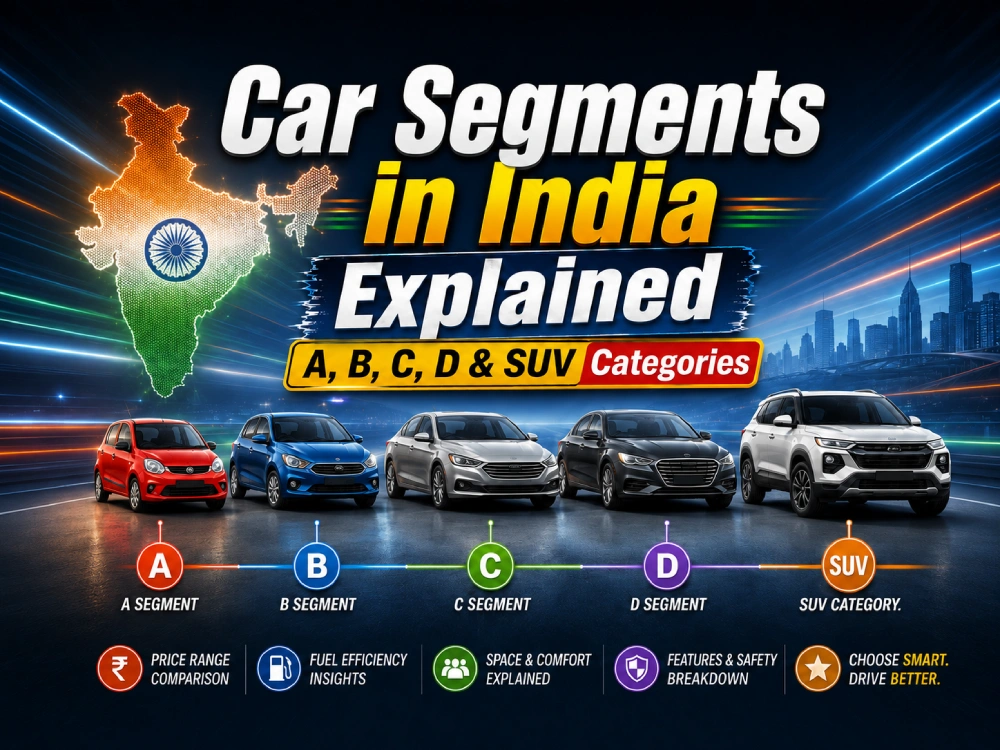
⏱️ Quick Answer: What are the Car Segments in India? Car segments in India categorize vehicles based on their length, body style, and purpose. The primary segments include:
- A-Segment (Mini Hatchbacks): Under 3.6 meters (e.g., Alto K10). Ideal for tight city traffic.
- B-Segment (Small Hatchbacks/Compact Sedans): Under 4 meters (e.g., Swift, Baleno). Best mix of mileage and space.
- C-Segment (Mid-Size Sedans & SUVs): 4 to 4.5 meters (e.g., Honda City, Hyundai Creta). Family-focused comfort.
- D-Segment (Executive/Luxury Cars): Above 4.5 meters (e.g., Skoda Superb, XUV700). Premium features.
Buying a car in India is a major life milestone. But the moment you walk into a dealership or read an automotive review, you are bombarded with industry jargon: "This is the best B-segment hatch," or "It dominates the C-SUV category."
If you are a first-time buyer navigating the chaotic bumper-to-bumper traffic of Gurgaon, or trying to find a safe parking spot in the crowded lanes of Noida, picking the wrong car size can ruin your daily driving experience.
Unlike global markets, car segments in India are heavily influenced by a unique government rule: The Sub-4-Meter Tax Rule. Vehicles under 4 meters in length with smaller engines enjoy massive tax cuts, which has given birth to uniquely Indian categories like the "Compact Sedan" and the "Sub-Compact SUV."
Whether you are looking for the safest car for your family or the ultimate SUV to tackle Delhi NCR potholes, this ultimate 2026 guide breaks down every car segment, compares their budgets, and helps you find the perfect machine.
💰 Car Segments by Budget (2026 Cheat Sheet)
Before we dive into the technicalities, let us look at what your money can buy. Indian car prices have shifted significantly, and setting a budget is the first step to choosing your segment.
| Your Budget (On-Road) | Best Segment Fit | Top Car Examples |
|---|---|---|
| Under ₹7 Lakhs | A-Segment / Entry B-Hatchback | Alto K10, Kwid, Celerio |
| ₹7 Lakhs to ₹10 Lakhs | Premium B-Segment Hatchbacks | Swift, Baleno, i20, Altroz |
| ₹10 Lakhs to ₹15 Lakhs | Sub-Compact SUVs & Compact Sedans | Nexon, Brezza, Dzire, Amaze |
| ₹15 Lakhs to ₹25 Lakhs | C-Segment SUVs & Mid-Size Sedans | Creta, Seltos, Honda City, Verna |
| ₹25 Lakhs and Above | D-Segment SUVs & Executive Sedans | XUV700, Safari, Superb, Fortuner |
👉 (Looking for maximum value? Read our guide on the 10 Best Cars Under Rs. 10 Lakhs in India).
📏 The Alphabet of Indian Cars: A, B, C, and D Segments Explained
Traditionally, cars are classified alphabetically based on their length and interior volume. Here is what these letters actually mean on Indian roads.
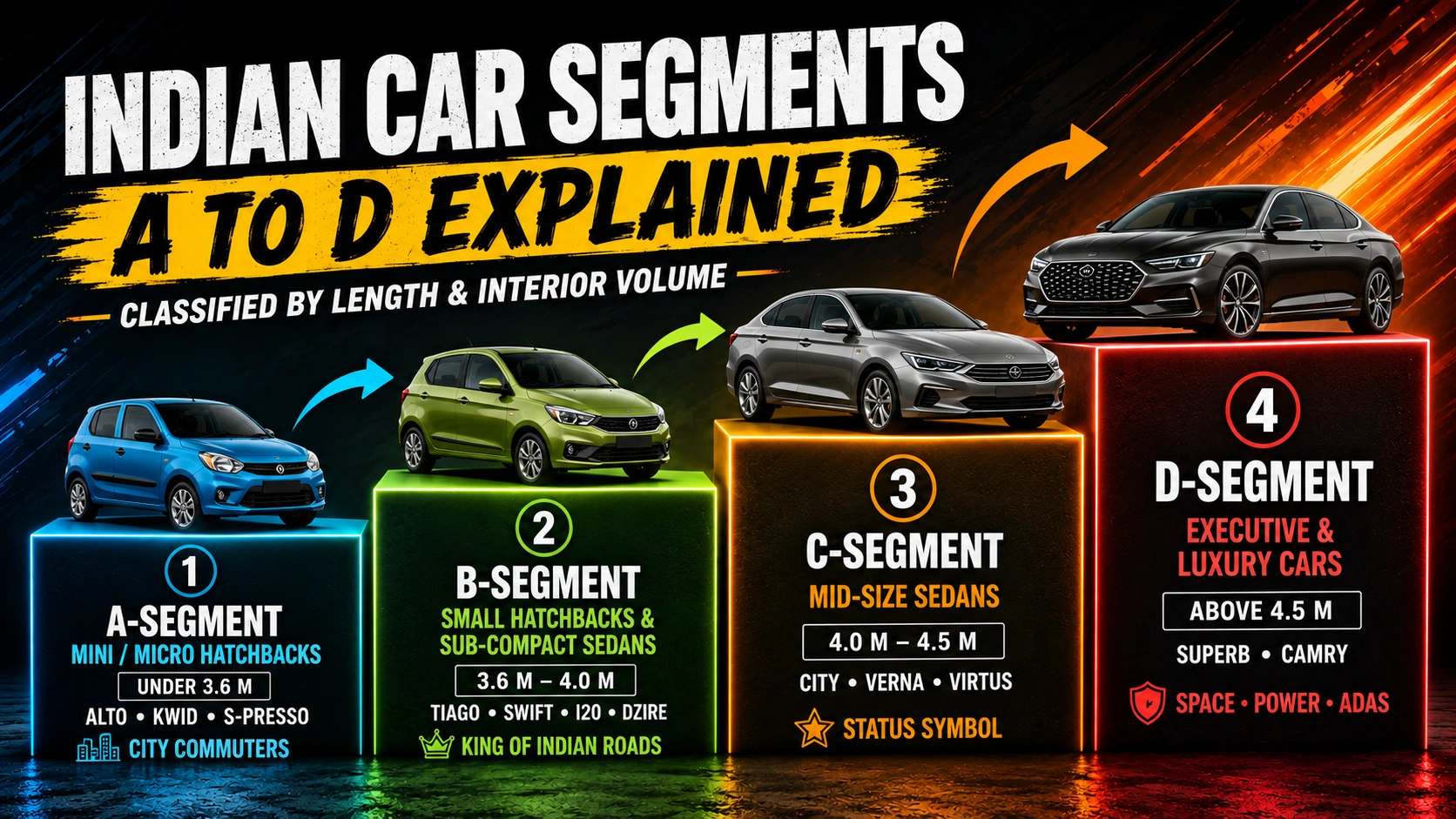
A-Segment: Mini / Micro Hatchbacks (The City Commuters)
Measuring strictly under 3.6 meters, these are the smallest cars available, powered by peppy 800cc to 1000cc engines.
- Who is it for? First-time buyers or families needing a secondary car. If you have to park in congested city colonies, an A-segment car is a lifesaver.
- Pros: Easy to park, highest mileage, cheapest maintenance.
- Cons: Very limited boot space, unstable at highway speeds.
B-Segment: Small Hatchbacks & Sub-Compact Sedans
Measuring between 3.6 meters and 4.0 meters, the B-segment is the undisputed king of Indian roads. This segment is divided into:
- B1 (Compact Hatchbacks): Maruti Celerio, Tata Tiago.
- B2 (Premium Hatchbacks & Compact Sedans): Maruti Swift, Hyundai i20, Maruti Dzire. (See the evolution of the Maruti Swift).
- Pros: Excellent balance of price, cabin space, and premium tech features (like sunroofs).
- Cons: Ground clearance can be an issue with 5 passengers onboard.
C-Segment: Mid-Size Sedans (The Status Symbol)
Ranging from 4.0 to 4.5 meters, C-segment sedans (Honda City, Hyundai Verna, VW Virtus) focus entirely on rear-seat comfort, aerodynamic stability, and massive boot space (500+ liters).
- Pros: Unmatched high-speed highway stability and rear-seat legroom.
- Cons: Low ground clearance makes them vulnerable to large speed breakers.
D-Segment: Executive & Luxury Cars
Measuring above 4.5 meters, the D-segment bridges the gap between mainstream cars and ultra-luxury brands. Cars like the Skoda Superb or Toyota Camry are large, powerful, and heavily loaded with Advanced Driver Assistance Systems (ADAS).
🚙 Decoding the Indian SUV Segments
In 2026, over 50% of all new cars sold in India are SUVs. Because "SUV" is a broad term, the industry has chopped it into distinct segments based on footprint:
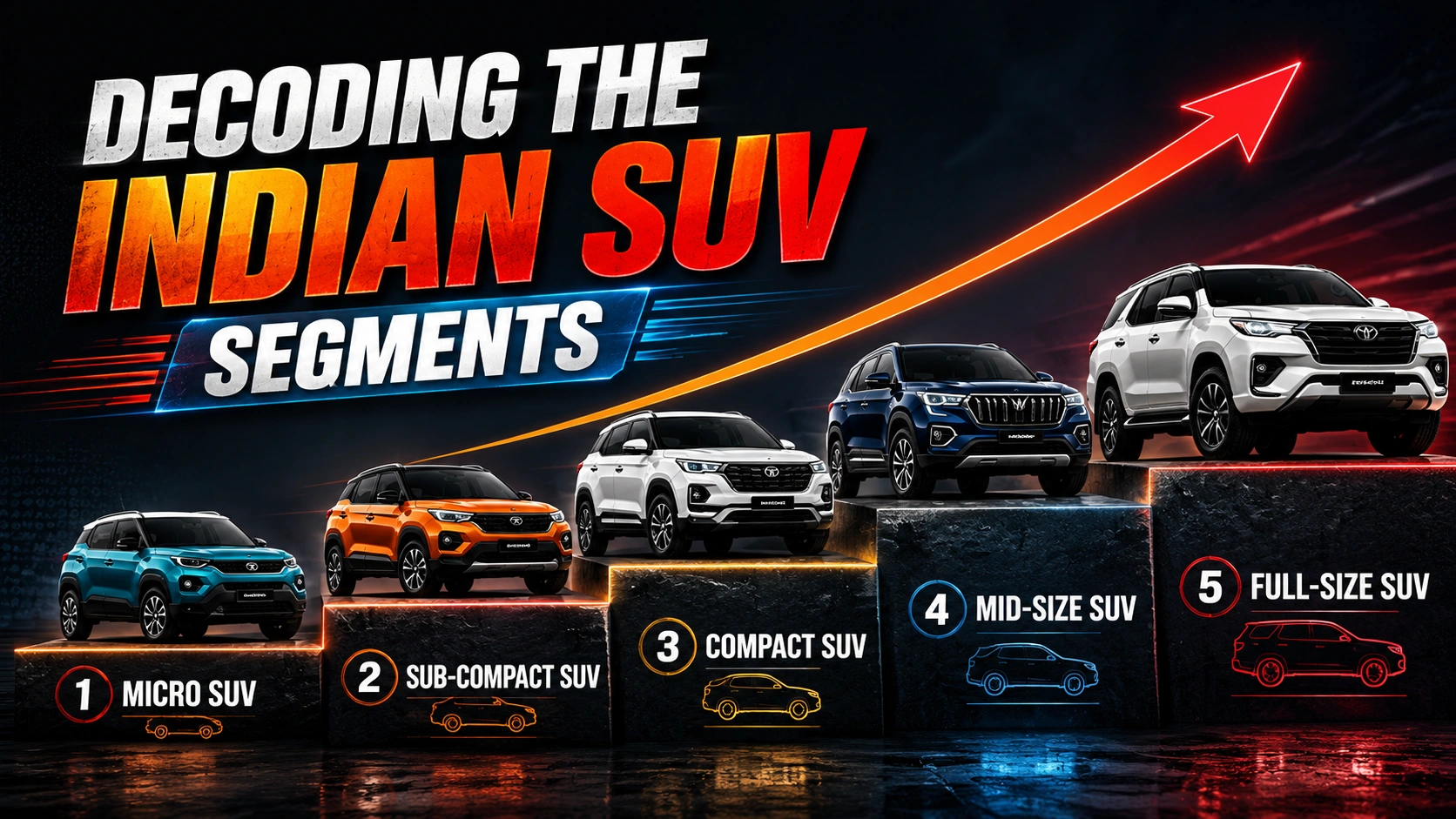
- Micro SUVs (A/B Segment footprint): Tata Punch, Hyundai Exter. High ground clearance with a tiny footprint.
- Sub-Compact SUVs (B-SUV): Tata Nexon, Maruti Brezza. Measuring exactly 3.99 meters to save on taxes, offering aggressive styling and powerful turbo engines.
- Compact SUVs (C-SUV): Hyundai Creta, Kia Seltos. Measuring around 4.3 meters, they offer genuine family space and massive panoramic sunroofs.
- Mid-Size SUVs (D-SUV): Mahindra XUV700, Tata Safari. Large, premium vehicles offering 3-row seating (6 or 7 seats).
- Full-Size SUVs: Toyota Fortuner, MG Gloster. Built on rugged ladder-frame chassis, measuring close to 5 meters, featuring genuine 4x4 off-road hardware.
🛑 The Safest Car Segment in India (2026 Trends)
Safety is no longer a luxury; it is the top priority for Indian buyers. With the introduction of Bharat NCAP (BNCAP) and stricter government mandates, safety dynamics have changed across segments:
- Standardization of 6 Airbags: In 2026, 6 airbags, ABS, and ESC are standard across almost all B2 Premium Hatchbacks and Compact SUVs.
- The Tata & Mahindra Influence: Indian manufacturers have forced global brands to build stronger chassis. Cars in the Sub-Compact SUV and Mid-Size SUV segments frequently score 5-star GNCAP/BNCAP ratings.
- ADAS (Advanced Driver Assistance Systems): If you want active safety features like Auto-Emergency Braking and Lane Keep Assist, you need to look at the C-SUV or D-Segment categories.
👉 (Read our detailed guide: 10 Popular Compact SUVs and Their Safety Ratings).
🛣️ Best Car Segment for Indian Roads?
Indian roads are unpredictable. A smooth highway can suddenly turn into a crater-filled dirt road. Which segment handles this best?
- For Potholes & Speed Breakers: The Sub-Compact SUV (B-SUV) and Compact SUV (C-SUV) segments are the absolute winners. With ground clearance ranging from 190mm to 208mm, cars like the Nexon or Creta glide over massive speed bumps without scraping their bellies.
- For Flooded / Waterlogged Streets: If you live in Mumbai or face heavy monsoons, Mid-Size & Full-Size SUVs offer higher wading depths, preventing water from entering the exhaust or cabin.
- For Highway Comfort: For smooth expressways, nothing beats the aerodynamic stability and zero-body-roll comfort of a C-Segment Sedan (like the VW Virtus).
💡 A Quick Tip for New Car Owners
No matter which segment you choose—whether it is a ₹7 Lakh hatchback or a ₹40 Lakh SUV—the harsh Indian sun, dust, and highway rocks will ruthlessly attack its factory paint. Before you hit the road, protect your investment with a 9H Nano Ceramic Coating or a self-healing Paint Protection Film (PPF). It keeps your car looking brand-new for years!
⚡ EV Car Segments in India
With electric vehicles becoming mainstream, the segments have mirrored their petrol counterparts, but with a silent, zero-emission twist:
- EV Hatchbacks (A/B Segment): Tata Tiago EV, MG Comet EV. Perfect for daily office runs with a running cost of just ₹1 per km.
- EV Compact SUVs (B/C Segment): Tata Nexon.ev, Mahindra XUV400, Tata Curvv.ev. The sweet spot for urban families.
- Premium EVs (D-Segment): BYD Seal, Hyundai Ioniq 5. Offering sports-car-like performance and 500+ km ranges.
🛠️ Maintenance Cost Comparison by Segment
When you buy a bigger car, you don't just pay more at the showroom—your ownership and detailing costs scale up. Here is the reality of maintaining them:
- A & B-Segment Hatchbacks: These are the cheapest to maintain. Because the surface area of the paint is small, premium car wash and detailing services cost significantly less.
- C-Segment Sedans: They require moderate maintenance. However, because they sit low to the ground, the lower front bumpers are highly prone to rock chips and tar build-up from highway driving.
- D-Segment & Full-Size SUVs: Maintaining a massive XUV700 or Fortuner requires a larger budget. Because of their massive surface area, washing takes longer, and they require larger volumes of protective liquid coatings.
Frequently Asked Questions (FAQs) on Car Segments
A car segment is an industry classification based primarily on the vehicle's length, body type (hatchback, sedan, SUV), and engine capacity to help buyers compare similar vehicles.
The A-Segment or B1-Segment (like Alto K10 or Tiago) is perfect for beginners. They have excellent visibility, are easy to park, and have cheap spare parts in case of minor scrapes.
C-Segment sedans (Honda City) are mid-sized (around 4.3 to 4.5 meters) and targeted at mainstream buyers. D-Segment sedans (Skoda Superb) exceed 4.5 meters, offering premium luxury, powerful engines, and a higher price tag.
No. Because of massive demand, SUVs are broken down into Micro, Sub-Compact, Compact, Mid-Size, and Full-Size segments based on their footprint.
B-Segment hatchbacks or Sub-Compact SUVs (like Nexon or Brezza) are ideal. They offer premium comfort but are small enough to weave through congested Delhi traffic.
The Sub-Compact SUV (B-SUV) segment is currently the most popular, offering the road presence of an SUV with the tax benefits of a small car.
A-segment and B-segment cars with 1.0L to 1.2L naturally aspirated engines provide the highest mileage in city conditions.
Thanks to new safety regulations in 2026, most Premium B-segment hatchbacks (like i20) and C-SUVs (like Creta/Seltos) offer 6 airbags in their mid-to-top trims under ₹15 Lakh.
Compact SUVs (like Creta) and B-segment hatchbacks (like Swift) historically hold the highest resale value due to massive second-hand market demand.
Only Full-Size SUVs (like Fortuner) or dedicated Lifestyle SUVs (like Thar or Jimny) with ladder-frame chassis and 4x4 capabilities are meant for actual off-roading.
An MPV (Multi-Purpose Vehicle, like Ertiga) is designed primarily for maximum passenger space and seating (7 to 8 seats). An SUV focuses on ground clearance, rugged styling, and all-terrain capabilities.
EVs follow the exact same size segmentation as petrol cars. A Tiago EV is a B-segment hatch, while a BYD Seal is a D-segment sedan.
The Hyundai Creta, Kia Seltos, and Maruti Grand Vitara fall under the C-SUV (Compact SUV) segment.
The Indian government levies lower GST and excise duties on cars that are strictly under 4,000mm in length and have engines smaller than 1.2L (petrol) or 1.5L (diesel).
Yes. Since detailing companies price their services based on the surface area of the vehicle, applying ceramic coating or PPF on an A-segment hatchback will be significantly cheaper than on a Full-Size SUV.
Related Blogs:
- Best Car Cleaning Service in Noida - Find the best car cleaning services in Noida and keep your car looking new.
- Car Detailing Products - Discover the best products for car detailing and how to use them to achieve a professional shine.
- Detailing Services for Different Cars - Learn about the different types of detailing services available for different types of cars and which one is best for you.
- Car Detailing for Different Seasons - Find out how to prepare your car for different seasons with the right detailing methods and products.
- How to clean your car's interior - Learn the 8 best techniques and products for cleaning the interior of your car, including the seats, dashboard, and carpets.

