




Tyre Rotation : What You Need To Know
When it comes to vehicle maintenance, most car owners strictly adhere to changing their engine oil, topping up the coolant, and ensuring their car's exterior shines with the help of a premium car wash or ceramic coating. However, one critical aspect of automotive upkeep that frequently flies under the radar is tyre rotation.
Your vehicle's tyres are its only point of contact with the road. They bear the entire weight of the car, absorb shocks from potholes, and provide the traction necessary to accelerate, steer, and brake safely. Ignoring tyre maintenance is not just a costly mistake—it is a safety hazard.
In this comprehensive guide, we will dive deep into everything you need to know about tyre rotation: what it is, why it is absolutely necessary, the various patterns used depending on your vehicle type, and how this simple maintenance task can save you thousands of rupees in the long run.
What Exactly is Tyre Rotation?
Tyre rotation is the practice of moving the wheels and tyres of an automobile from one position to another to ensure even tyre wear. Even tread wear extends the useful life of a set of tyres.
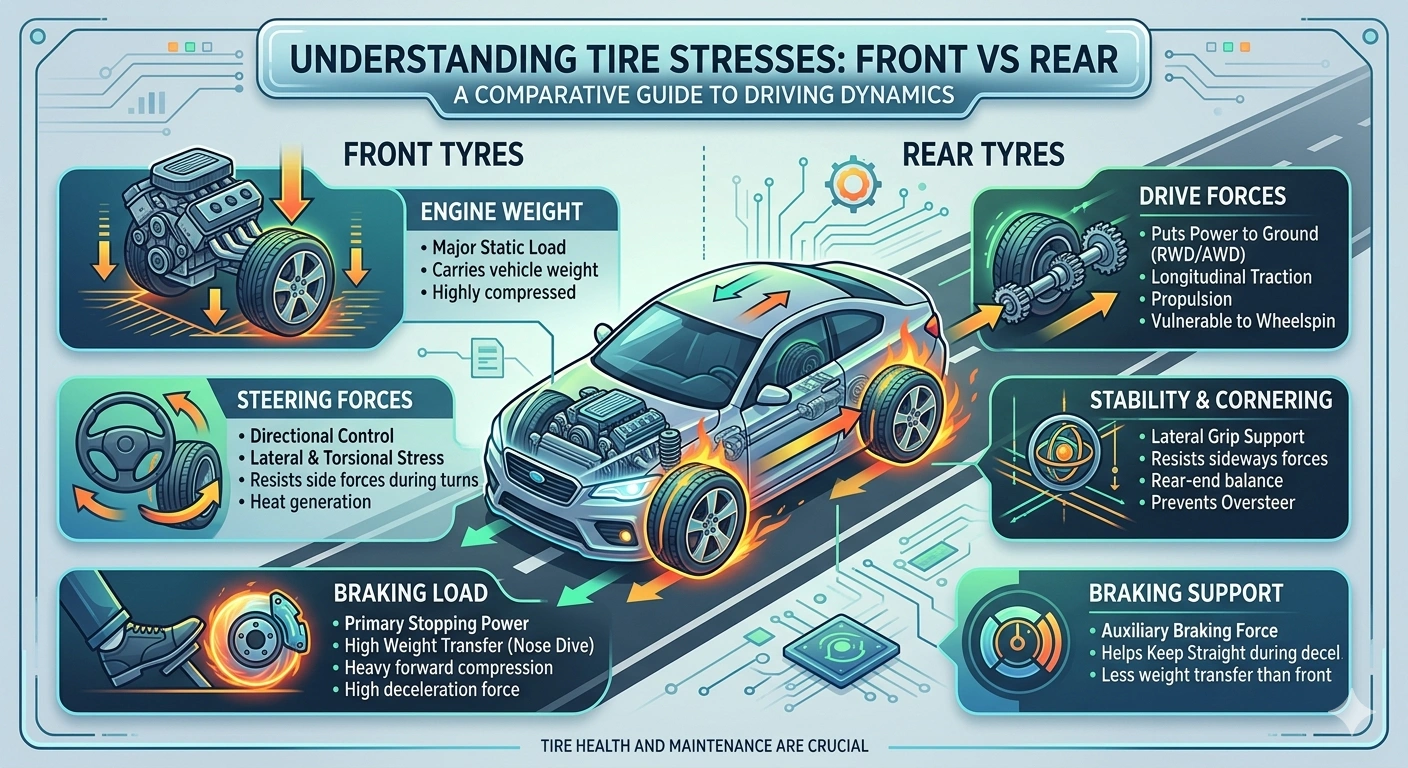
The weight of a vehicle is not distributed evenly across all four corners. For instance, the engine—usually the heaviest component of a car—is typically located at the front. This means the front tyres carry a heavier burden than the rear tyres. Furthermore, front tyres handle the bulk of the steering forces and, in most modern cars (which are front-wheel drive), the acceleration forces as well. Braking also shifts the vehicle's weight forward, placing immense stress on the front rubber.
Because of these unequal forces, tyres naturally wear down at different rates and in different patterns depending on their position on the car. By periodically shifting the tyres to different positions, you distribute this wear and tear more evenly across all four tyres.
The Top Benefits of Regular Tyre Rotation
Why should you go through the hassle of booking an appointment to have your wheels swapped around? Here are the most compelling reasons to make tyre rotation a staple of your regular vehicle maintenance routine.
1. Extends Tyre Lifespan
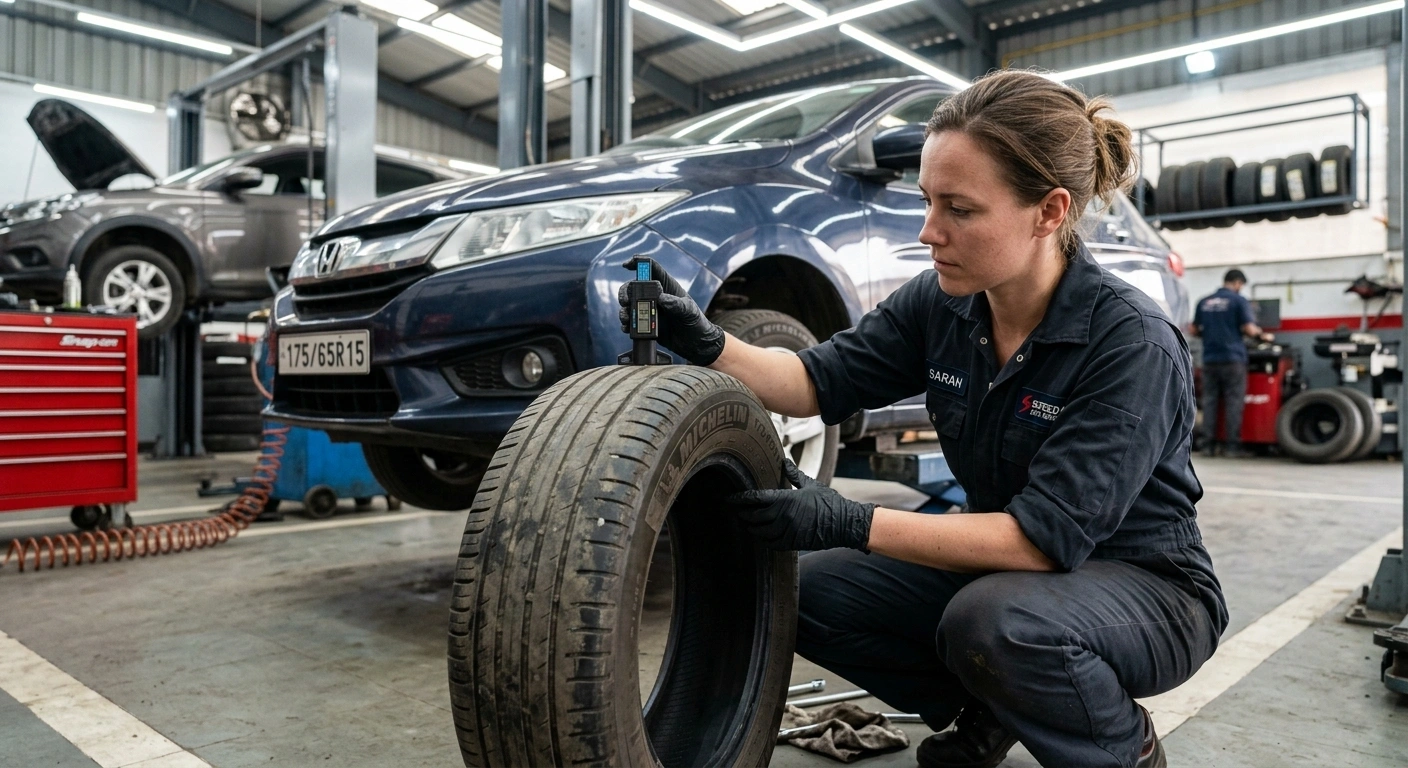
Tyres are not cheap. Replacing a complete set of high-quality rubber can take a significant toll on your wallet. By rotating your tyres regularly, you ensure that the tread wears down evenly across all four tyres. Without rotation, the front tyres of a front-wheel-drive vehicle will wear out significantly faster than the rears, forcing you to replace them prematurely. Even wear maximizes the usable life of the tyre, giving you the best return on your investment.
2. Enhances Vehicle Handling and Safety
When tyres wear unevenly, the vehicle's handling characteristics change. Deep, healthy tread is crucial for gripping the road, especially in adverse weather conditions like heavy rain. If your front tyres are worn bald while your rears are practically new, your vehicle becomes susceptible to understeer and hydroplaning. Even tread depth ensures consistent handling and keeps your braking distances as short as possible.
3. Improves Fuel Efficiency
Unevenly worn tyres increase a vehicle's rolling resistance—the friction that must be overcome to keep the car moving. When rolling resistance increases, the engine has to work harder to maintain speed, which in turn consumes more fuel. Keeping your tyres rotated and correctly inflated is one of the easiest ways to maintain your vehicle's factory fuel efficiency.
4. Protects the Suspension and Drivetrain
Tyres that are severely unevenly worn can cause vibrations that travel through the chassis of the vehicle. Over time, these vibrations place unnecessary stress on suspension components, wheel bearings, and your vehicle's drivetrain. For All-Wheel Drive (AWD) vehicles, evenly worn tyres are absolutely critical. A significant difference in tyre diameter (caused by uneven wear) can strain the AWD system, potentially leading to catastrophic mechanical failure.
5. Preserves the Tyre Warranty
Most tyre manufacturers offer treadwear warranties that guarantee the tyre will last for a certain number of miles. However, if you read the fine print, these warranties almost always require proof of regular tyre rotation. Failing to rotate your tyres can void this warranty, leaving you unprotected if the tyres fail prematurely.
How Often Should You Rotate Your Tyres?
The frequency of tyre rotation depends on several factors, including the type of vehicle you drive, your driving habits, and the specific recommendations of the tyre manufacturer.
As a general rule of thumb, most automotive experts and manufacturers recommend rotating your tyres every 5,000 to 8,000 kilometers (or roughly every 3,000 to 5,000 miles). A convenient way to remember this is to have your tyres rotated every time you go in for an oil change or standard maintenance service.
However, different drivetrains impact tyres differently:
- Front-Wheel Drive (FWD): The front tyres handle steering, braking, and putting power to the road. They wear much faster than the rears. Regular rotation is vital here.
- Rear-Wheel Drive (RWD): The rear tyres provide the power, while the front handles the steering. Wear is slightly more balanced than FWD, but rotation remains crucial.
- All-Wheel Drive (AWD) / Four-Wheel Drive (4WD): AWD systems require all four tyres to have near-identical tread depths to prevent drivetrain damage. Some experts recommend rotating AWD tyres even more frequently—perhaps every 3,000 to 5,000 kilometers.
Understanding Tyre Rotation Patterns
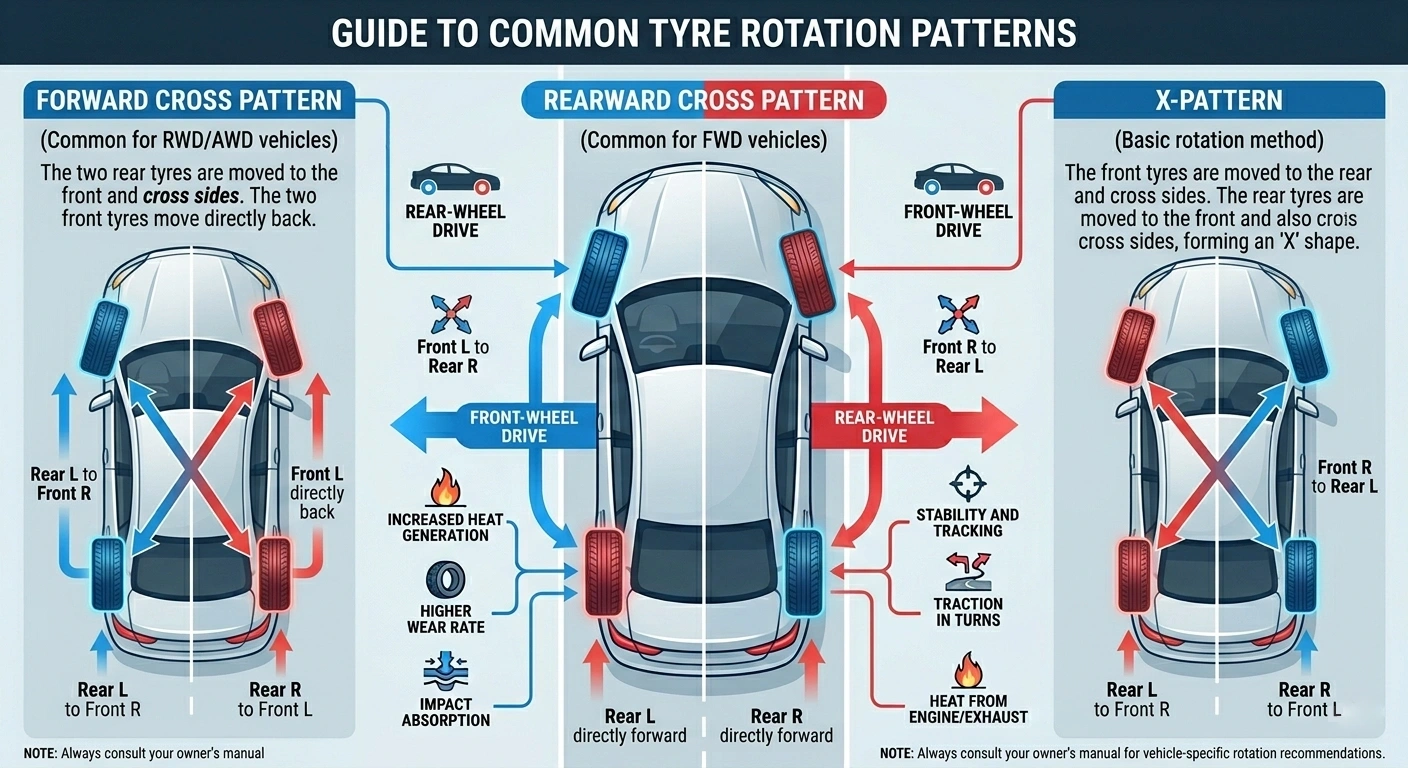
You cannot simply swap tyres randomly. Automotive engineers have devised specific rotation patterns to optimize wear. The correct pattern depends on the vehicle's drivetrain, whether the tyres are directional, and whether the front and rear wheels are the same size.
Here are the standard rotation patterns recognized by the automotive industry:
1. The Forward Cross Pattern
- Best For: Front-Wheel Drive (FWD) vehicles.
- How it Works: The front tyres are moved straight back to the rear. The rear tyres are moved to the front but crossed over to the opposite side (e.g., the right rear tyre becomes the left front tyre).
2. The Rearward Cross Pattern
- Best For: Rear-Wheel Drive (RWD), All-Wheel Drive (AWD), and 4-Wheel Drive (4WD) vehicles.
- How it Works: The rear tyres are moved straight up to the front. The front tyres are moved to the rear but crossed over to the opposite side (e.g., the right front tyre becomes the left rear tyre).
3. The X-Pattern
- Best For: FWD vehicles, as well as lightweight trucks and sedans.
- How it Works: All tyres are moved diagonally. The left front tyre goes to the right rear, the right front goes to the left rear, and so on.
Special Considerations for High-Performance Tyres
If you drive a sports car or a high-performance vehicle, you might encounter different types of tyres that cannot follow standard rotation patterns:
- Directional Tyres: These tyres have a specific tread pattern designed to roll in only one direction (usually to channel water away efficiently). They have arrows on the sidewall indicating the direction of rotation.
Rotation Pattern: Front-to-Rear. The left front tyre is swapped with the left rear, and the right front is swapped with the right rear. They cannot cross sides, or they will spin backwards. - Staggered Fitment: Many performance cars feature larger tyres in the back and smaller tyres in the front.
Rotation Pattern: Side-to-Side. The rear tyres are swapped left-to-right, and the front tyres are swapped left-to-right. They cannot move front-to-back because of the size difference. If the staggered tyres are also directional, they cannot be rotated at all without dismounting them from the wheels.
Tyre Rotation vs. Wheel Alignment vs. Wheel Balancing
A common misconception among car owners is confusing tyre rotation with wheel alignment or wheel balancing. While all three are essential for tyre health, they serve completely different purposes.
- Tyre Rotation: Changing the physical location of the tyres on the vehicle to promote even wear.
- Wheel Alignment: Adjusting the suspension of the vehicle—the system that connects a vehicle to its wheels. It is not an adjustment of the tyres or wheels themselves. Proper alignment ensures the tyres make optimal contact with the road at the correct angle. If your car pulls to one side, you need an alignment.
- Wheel Balancing: Ensuring that the weight of the tyre and the wheel is perfectly distributed evenly around the axle. Mechanics use a machine to find heavy spots and attach small lead weights to balance the assembly. If your steering wheel vibrates at highway speeds, you likely need a wheel balance.
If you are replacing a set of tyres or getting a rotation, it is often a good idea to have the balancing and alignment checked simultaneously to ensure a smooth ride.
5 Signs You Desperately Need a Tyre Rotation
If you haven't been keeping track of your mileage, your car will often tell you when it's time for a rotation. Watch out for these warning signs:
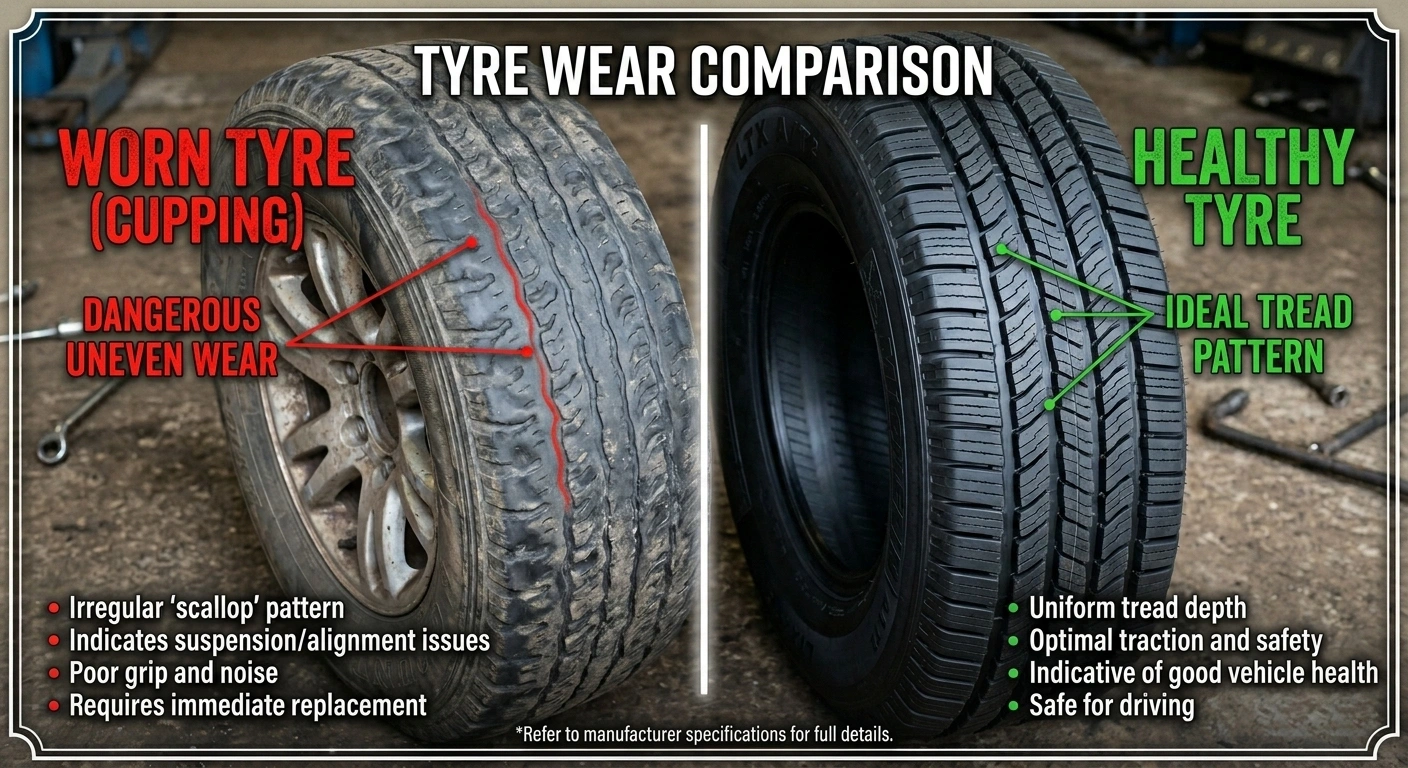
- Uneven Wear Between Front and Rear: Park your car and turn the steering wheel all the way to one side so you can see the front tread. Compare it to the rear tread. If the front looks significantly more worn, book a rotation.
- Feathering or Cupping: Run your hand over the tread blocks. If the tread feels smooth in one direction but rough in the other (feathering), or if there are smooth dips in the tread (cupping), you are experiencing irregular wear.
- Vehicle Vibrations: While vibrations can indicate balancing issues, severely uneven tyre wear can also send shudders through the steering wheel or seat.
- Loss of Tyre Pressure: If one tyre consistently loses pressure faster than the others, it might be bearing too much weight and wearing abnormally.
- Increased Road Noise: Tyres that wear unevenly tend to become noisier. If the hum of the road sounds more like a loud roar, your tread might be compromised.
Can You Rotate Your Tyres Yourself?
Technically, yes. If you have a solid, flat surface, a hydraulic floor jack, a set of robust jack stands, a lug wrench, and a torque wrench, you can perform a tyre rotation in your driveway.
However, there are distinct advantages to having this service performed by professionals, such as the technicians at a Detailing Devils Studio.
When professionals rotate your tyres, they do more than just swap the wheels. A professional service usually includes:
- A thorough inspection of the tyres for nails, cuts, or sidewall bulges.
- Checking the brake pads and rotors while the wheels are off.
- Checking for suspension wear.
- Ensuring the lug nuts are tightened to the exact manufacturer-specified torque using a calibrated torque wrench. (Over-tightening can warp brake rotors, while under-tightening can cause the wheel to fall off!)
- Adjusting the tyre pressure to the correct PSI.
Beyond Rotation: Protecting Your Tyres and Vehicle
While tyre rotation handles the mechanical wear, what about the aesthetic and environmental protection of your wheels and the rest of your vehicle?
Road grime, brake dust, and UV rays can cause tyres to crack, fade, and turn an ugly shade of brown. To keep your wheels and tyres looking immaculate, consider applying protective coatings. For instance, Tyre Armor provides a hydrophobic layer that repels dirt, restores a deep black satin finish, and protects the rubber from UV degradation. Similarly, protecting your alloys with specialized nano-coatings makes cleaning brake dust incredibly easy.
Protecting your vehicle goes far beyond the rubber. Just as you rotate tyres to preserve them, investing in high-quality exterior protection preserves your car's paint. Consider advanced solutions like Ceramic Coating to protect against micro-scratches, chemical stains, and UV damage, or opt for Dragon PPF (Paint Protection Film) for ultimate physical defense against rock chips and road debris.

The Final Verdict on Tyre Rotation
Tyre rotation is a minor, inexpensive, and quick maintenance task that yields massive dividends. It ensures your safety, improves your car's fuel economy, provides a smoother ride, and delays the hefty expense of buying new tyres.
Don't wait until your tyres are bald on one side. Check your owner's manual, set a schedule, and stick to it. If you're unsure when your tyres were last rotated, there is no better time than now to get them checked.
Whether you need a comprehensive exterior detailing, advanced paint protection, or just expert advice on maintaining your vehicle's aesthetic and functional value, we are here to help. Locate a store near you and let the experts at Detailing Devils take your vehicle care to the next level.
Related Blogs:
- Best Car Cleaning Service in Noida - Find the best car cleaning services in Noida and keep your car looking new.
- Car Detailing Products - Discover the best products for car detailing and how to use them to achieve a professional shine.
- Detailing Services for Different Cars - Learn about the different types of detailing services available for different types of cars and which one is best for you.
- Car Detailing for Different Seasons - Find out how to prepare your car for different seasons with the right detailing methods and products.
- How to clean your car's interior - Learn the 8 best techniques and products for cleaning the interior of your car, including the seats, dashboard, and carpets.

